

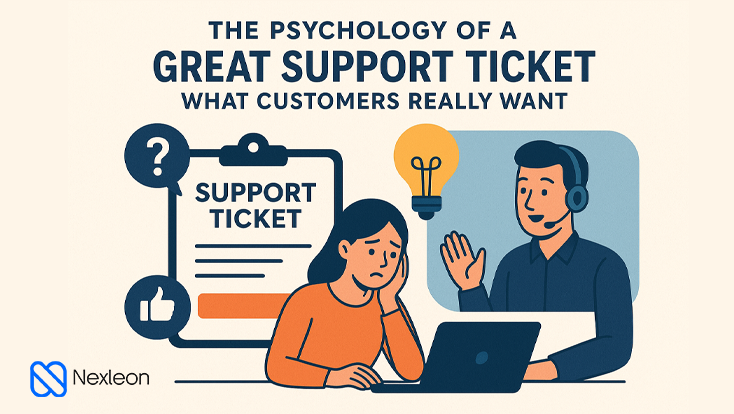
Customers coming to your support desk are looking not just for solutions but for reassurance. How a business approaches support tickets may make or break customer relationships. A badly composed response can turn minor frustration into brand distrust, whereas a well-thought-out, empathetic message will transform a complaint into loyalty.
At Nexleon, great customer support is less about processes and more about people. The first step in building lasting connections lies with understanding the psychology of what customers really want when they put in a ticket.
1. The Emotion Behind Every Ticket
Every support ticket has emotion: frustration, confusion, disappointment, or sometimes panic. When a customer reaches out to support, it’s rarely just about the product issue; it’s about how that issue makes them feel.
For instance, when a user cannot get into his or her account, the problem is not only technical. There is an emotional layer to feeling locked out, worried about data loss, and even embarrassed if it is a work matter. Acknowledging this emotion helps your helpdesk team give an empathetic response rather than a robotic, technically correct one.
The best support agents don’t just fix problems; they acknowledge feelings. A simple phrase like “I understand how frustrating that must be” sets a tone of compassion that can calm a customer before a solution is even offered.
2. The Power of First Impressions
In customer support, response time and tone are the new first impressions.
A customer submitting a ticket expects acknowledgment — at least an automated confirmation — in nearly real-time. What really matters, though, is what the first message says. It should make the customer feel seen and prioritized, not like another entry in a queue.
Here is what customers subconsciously want in that first contact:
- Validation: That their concern is real and does matter.
- Certainty: That someone capable is handling it.
- Predictability: A clear idea of when they can expect a resolution.
These psychological cues help businesses like Nexleon in designing the workflow of a help desk, balancing automation with personalization to make sure each ticket starts with empathy, clarity, and reassurance.
3. Clarity Beats Complexity
Though a support ticket is apparently a technical discussion, it’s all about communication clarity. When responses are full of jargon or overexplained solutions, customers feel alienated.
Clarity builds trust. Here’s how to achieve it:
- Use simple language: Write as if you’re explaining the issue to a friend.
- Structure your response: Problem → Reason → Solution → Next Steps.
- Avoid blame: Even if user error caused the problem, focus on resolution, not fault.
Thus, when customers read a clear and confident reply, they feel in control again. That sense of control is deeply satisfying — it restores confidence not only in the product but in the company itself.
4. The Psychology of Empathy
Empathy is more than being nice; it’s about mirroring the customer’s emotions and offering calm leadership through their problem.
When customers feel heard, they become more complacent and forgiving. Many such studies revealed that an empathetic tone can diminish negative feedback even when a resolution is not found right away.
Consider these two responses, for instance:
❌ “We’re looking into it and will get back soon.”
✅ “I fully understand how inconveniencing this might be on your end. I, myself, am checking into this with our technical team. I will update you in the next couple of hours.”
The second message gives empathy, ownership, and timeframe – three psychological cues which build trust. That’s what makes a great help desk team.
At Nexleon, empathy is key in our philosophy of customer support. We train teams to respond as humans first and professionals second-because in the customer’s eyes, a kind message is sometimes more powerful than an instant solution.
5. The Importance of Transparency
Customers value honesty more than perfection. If the solution will take time, it is better to communicate openly rather than leaving them waiting in silence.
Transparency triggers trust-based reassurance: a feeling that the company respects their time and intelligence. Even simple updates like “Our engineers are still testing the fix, and we’ll update you at 3 PM” reduce anxiety and strengthen the relationship.
It also prevents negative emotional spirals. A customer who is aware of what’s going on is unlikely to escalate or feel snubbed.
In the psychology of the customer, silence equals uncertainty, and uncertainty breeds frustration. A quick update, even without new information, can make all the difference.
6. Personalization: Making Customers Feel Valued
Customers love to be recognized, and using their name, remembering their previous issues, or referring to their account history shows care. This is where CRM and helpdesk integration can become powerful.
By integrating data across multiple touchpoints, a business such as Nexleon can provide customized responses to make its customers feel known, not numbered.
Instead of “Dear user”, imagine this:
“Hi Sarah, I noticed this is the same issue you faced last month. Let’s fix it permanently this time.”
That kind of personalization creates emotional loyalty-the kind that marketing alone can’t buy.
7. The Science of Resolution Satisfaction
Psychologically, customers don’t measure satisfaction with whether their issue was solved; they measure it by how they felt during and after the process.
Even if a solution takes time, customers leave happy if:
- They were treated with empathy.
- They were kept posted.
- They felt they were heard and their ideas respected.
This is called the peak-end rule in psychology: people remember the most emotional part of the experience and how it ended. So, if there is a strong closing message like, “I’m really glad we got this sorted for you, and thank you for your patience,” then that creates a positive emotional memory.
At Nexleon, we design customer interactions with this in mind: every ticket, no matter the complexity, must end on a high note.
8. Feedback as a Psychological Loop
The ticket doesn’t end when it’s closed. Asking for feedback — genuinely — creates a sense of partnership.
Asking for a customer’s opinion makes them feel empowered. It tells them, in effect: “Your voice shapes how we improve.” That psychological inclusion turns ordinary users into advocates.
However, requests for feedback should sound conversational, not corporate. For example:
✅ “We’d love your honest thoughts on how we handled this.”
❌ “Please take this survey on customer satisfaction.
The wording counts: People respond emotionally before they respond logically, and a warm tone can increase response rates significantly.
9. Translating Psychology into Strategy
Understanding the psychology of support tickets isn’t just about empathy; it’s a business strategy.
Companies that master emotional intelligence in customer support see measurable benefits:
- Higher customer retention rates
- Reduced churn
- Improved online reputation
- Increased referrals and upsells
When a customer feels taken care of, they stay and promote the brand. It also means each ticket is an opportunity to build loyalty.
Companies like Nexleon don’t look at support as a cost center; they actually see it as a trust center. Every response, every tone, and every update is an investment in the customer relationship.
10. The Takeaway: Customers want to be understood
Customer support is, at its core, human-to-human communication. However advanced the tools, or automated systems, what customers really want is quite simple:
- To be heard
- To be helped
- To be respected
A great support ticket does all three through empathy, clarity, and transparency.
When your helpdesk understands the psychology driving customer behavior, every message becomes more than a response-it’s an experience.
That is what Nexleon is all about: enabling companies to transform support tickets into long-term relationships, one conversation at a time.
Final Thoughts
The psychology of a great support ticket is about connecting emotion to action. It’s about giving customers more than answers-giving them confidence. When you make every interaction personal, transparent, and empathetic, you don’t just resolve issues-you build trust that lasts.
Because, at the end of the day, customer satisfaction isn’t measured by how fast you reply; it’s measured by how deeply you care.